


As usual at the graduate school's introductory meetings, a wide range of research projects were presented. This involves completely new research in everything from older adult abuse in dental care and how to communicate with older adults, to why so many who wish to die at home instead do so, against their will, in a care environment.
Other exciting research areas that the new PhD students are investigating are how older adults are affected by climate change heat waves, loneliness, what facilitates/difficulties the older adults' physical activity and a completely new mathematical instrument for evaluating the final stages of life in palliative care.

– I discovered SWEAH at the graduate school's gerontology course in Gothenburg a year ago. I am attracted by the international exchange and to be able to take part in other aspects and perspectives of aging. It does something to you when we meet for real. I myself work in healthcare science, but need to broaden my knowledge, for example in biology and sociology, says Camilla Allert, a new PhD student from the partner university Linnaeus University.
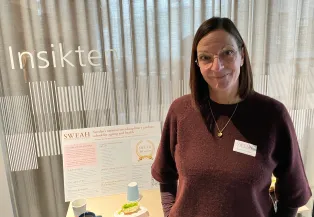
– I am mainly interested in networking and alumni activities, anything that opens up new contacts. I might continue at SAIN after my time at SWEAH. You need support and networking even after your doctoral studies, says Annicka Appelberg, a new PhD student from partner university Kristianstad University.
Every fall, doctoral students from SWEAH's partner universities can apply to the graduate school.
Here are all of this year's newly joined SWEAH PhD students and their research projects
| Name | Home university | Disciplinary orientation | Project/ thesis title | |
|---|---|---|---|---|
| Todorov | Johannes | Jönköping University | Health Sciences with a specialization in oral health, focusing on the intersection of gerontology, public health, and social vulnerability. | Identifying Elder Abuse: The Role of Dental Care Professionals and Neglected Oral Health |
| Appelberg | Annicka | Kristianstad University | Reg. Occupational Therapist / Occupational Therapist, Specialist in Rehabilitation Medicine/Health Sciences | Care and Daily Life at Home with Parkinson’s Disease |
| Thermaenius | Ingrid | Linköping universitet, Institutionen för kultur och samhälle (IKOS) Avd. Socialt arbete | Social work | The role of the social worker in collaboration with people with dementia |
| Johansson | Johanna | School of Health and Welfare, Jönköping University | Health and care sciences | Tentiative title: The impact of heatwaves on the health and wellbeing of community dwelling older adults - experiences and adaptive strategies for outdoor activities in an urban environment |
| Jacobsen | Juliet | Lund University, Medical Oncology | Palliative Care | Time and Timing in Serious Illness: An exploration to optimize the visualization and analysis of patients’ palliative care needs |
| Lindhagen | Sébastien | Dalarna University | Care Sciences | Understanding and assesing loneliness in older adults |
| Kim | Hyeji | Lund University | Social Work | Person-Centered Care as Perceived by Older Home Care Users in Sweden: A Mixed-Methods Study on the Impact of Intersectional Discrimination and Service Characteristics |
| Allert | Camilla | Linnaeus University | Caring science | Co-creation as a way to enable participation and mutual learning to improve mealtime situations in nursing homes |
| Andersson | Emelie | Lund University, Department of Clinical Sciences, Malmö, Faculty of Medicine | Health Economics | Navigating the Complexities of Elderly Care: Health Economic Evaluations of Integrated and Intensive Care Solutions |
| Eriksson | Sofia | Umeå University | Physiotherapy | Supporting and evaluating implementation of physical exercise initiatives for older persons in a municipality in Sweden - a multiple case study |
| Hellgren | Sanna | Kristianstad University | Caring science | Person-centred communication with and for older adults – Skills training in nursing education and later application in primary care in home settings |
| Abaci | Alara | Karolinska Institutet | Medicine, Geriatrics, Health communication, Medical sciences, Medical communication, Risk factors for Dementia, Dementia prevention, Behavioural sciences, Psychology, Implementation science, Digital health, Shared decision-making | Medical communication about dementia risk and digital multidomain dementia prevention |
| Saellström | Suzanne | Umeå University | Occupational therapy | Promoting active ageing through proactive approaches to housing and relocation |
| Johansson Afreixo | Ari | Karolinska Institutet | Health Science | Just an ordinary death? Co-researching the End-of-Life with support from homecare. |
| Ma | Yiming | Karolinska Institutet | Nutritional and geriatric epidemiology | Personalised Diet for Healthier Longevity: the Role of Dietary Changes, Sensitive Windows of Exposure, Psychosocial Background, and Morbidity |